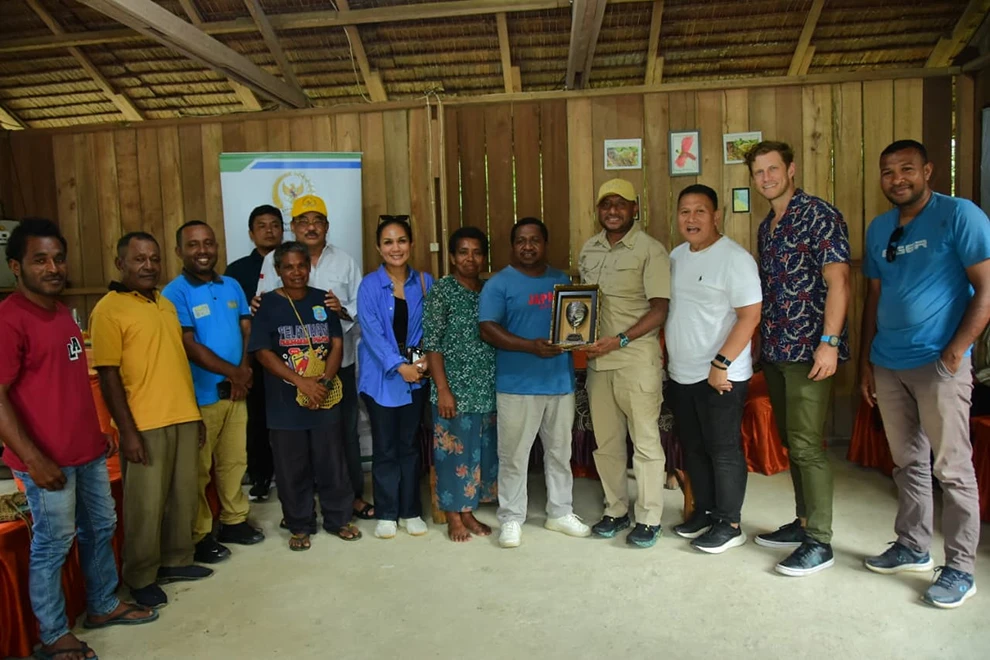
ICCF Indonesia and members of the Indonesian House of Representatives met with the Warimpuren Homestay Association, a grassroots institution that has emerged as one of the region’s strongest examples of community-led tourism and conservation.
Saporkren, Raja Ampat — During a series of engagements with local stakeholders in Southwest Papua, ICCF Indonesia and members of the Indonesian House of Representatives (BKSAP Working Group on Blue Economy) met with the Warimpuren Homestay Association, a grassroots institution that has emerged as one of the region’s strongest examples of community-led tourism and conservation. The dialogue highlighted how homestays, once among the sectors hardest hit by the pandemic, have rebuilt themselves through collective action, local leadership, and an inclusive economic model rooted in blue economy principles.
A Community Network Rebounding After Crisis
Before COVID-19, Raja Ampat hosted nearly 200 homestays, mostly run by local families. When tourism collapsed, around 70% were forced to close. Supported by EcoNusa and strengthened by cooperation among island communities, the association initiated a phased recovery. Today, 166 homestays have returned to operation, with 31 new units preparing to join — a remarkable rebound for a remote, community-driven tourism network.
The association also operates its own online booking platform, giving guests access to verified community-run homestays through a transparent, locally managed system.
A Model of Inclusive and Sustainable Tourism
The homestay network acts as a local economic multiplier: guests rely on village boat operators, buy fish from local fishermen, and consume agricultural products grown by women farmers in places like Batanta. This integrated supply chain ensures that tourism benefits reach households across multiple sectors.
To prevent concentration of ownership and promote broad participation, the association enforces a maximum of ten homestay units per member, a rule that impressed the DPR-RI delegation.
Hon. Mardani Ali Sera, Chair of BKSAP and Co-Chair of the Conservation Caucus, highlighted the integrity of the association’s governance:
"They only own ten homestays. Why? So that everyone else can also earn a livelihood. That is part of their ethics — so that prosperity is shared."
He also commended the association’s discipline in guest service:
"They have a very good association. Incoming bookings must be responded to quickly, and if one homestay is full, the system redirects guests to another. This is a system built on mutual trust."
Institution Building Rooted in Local Leadership
Although formally established in 2013, the association traces its roots back to 2007 when pioneering families first opened homestays for visiting divers. Over time, it has built strong internal governance systems such as:
- annual inspections and quality assurance
- a centralised booking website (stayrajaampat.com)
- secure payment management through a locally registered Limited Liability Company (PT)
- collective training and peer learning
- structured support for new homestay owners
These systems maintain high service standards while ensuring local ownership over key tourism assets.
Challenges and Emerging Pressures
While recovery has been strong, challenges remain:
- logistical constraints and limited transport access
- emerging mining threats to forests and coastal ecosystems
- increasing competition requiring stronger service coordination
- infrastructure gaps, particularly roads and inter-island access
To diversify livelihoods, the association is preparing to strengthen agriculture and fisheries as complementary sectors for households not directly involved in homestay operations.
A Clear Path Forward for Sustainable Community Livelihoods
The visit underscored the importance of coordinated support among government, civil society, and local communities to maintain community-based tourism as a driver of conservation and shared prosperity. Key priorities include improving infrastructure, enhancing market access, supporting diversified livelihoods, and ensuring tourism growth remains aligned with ecological protection.
For ICCF Indonesia and DPR-RI, the homestay association represents a powerful example of community-led blue economy practice, a model of resilience, cooperation, and sustainable development that can be scaled across Indonesia’s coastal regions.
 Regional Headquarters